Admin
Admin 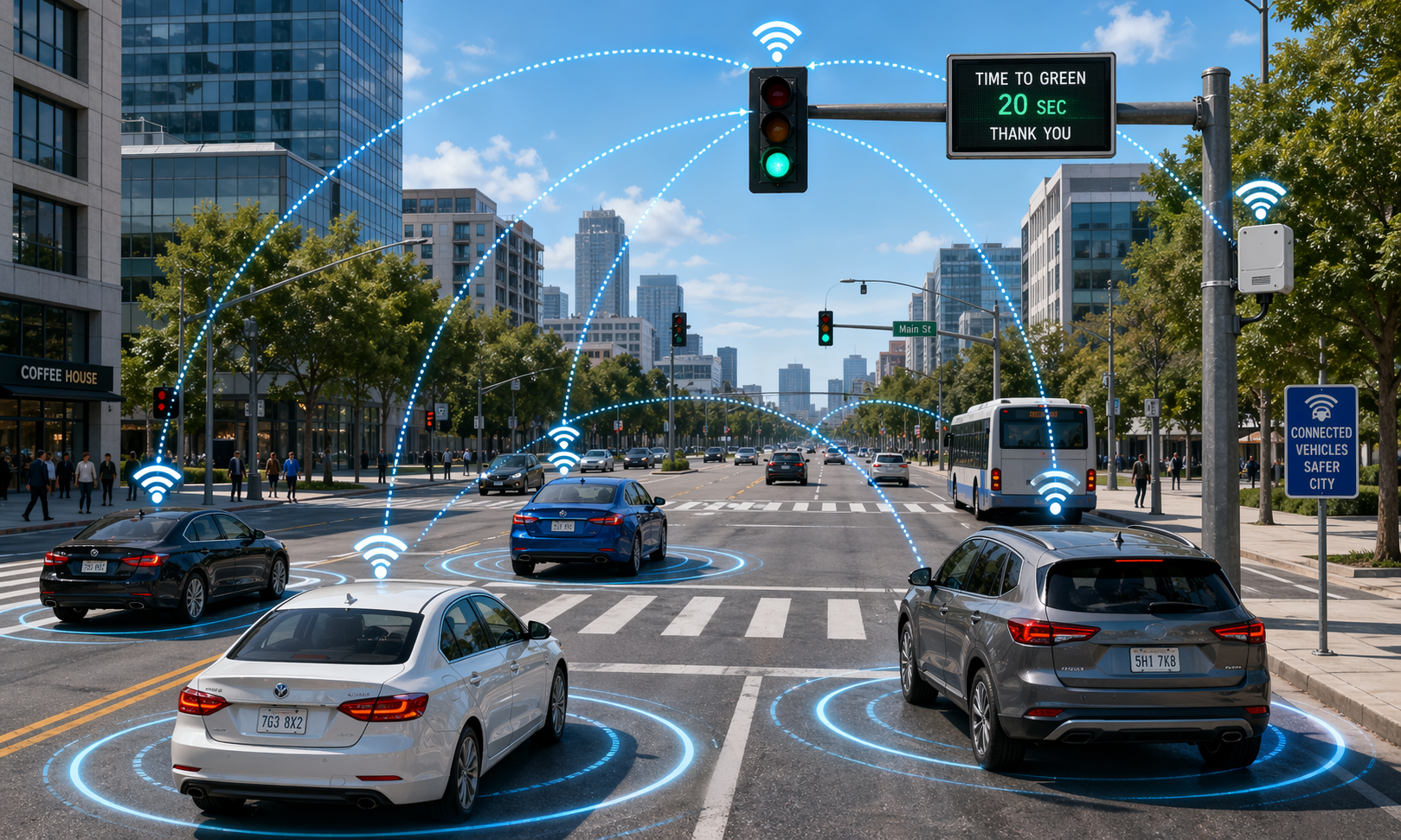
The transportation frontier is emerging with a lot of speed with urban centers experiencing congestion, safety issues and the issue of mobility on the rise. Vehicle-to-Everything (V2X) is becoming one of the radical solutions capable of linking the vehicles to their environment to form intelligent traffic ecosystems. V2X is transforming the traffic system, making it more responsive, efficient, and safe by allowing real-time communication between vehicles and infrastructure, pedestrians, as well as networks.
What is V2X Communication?
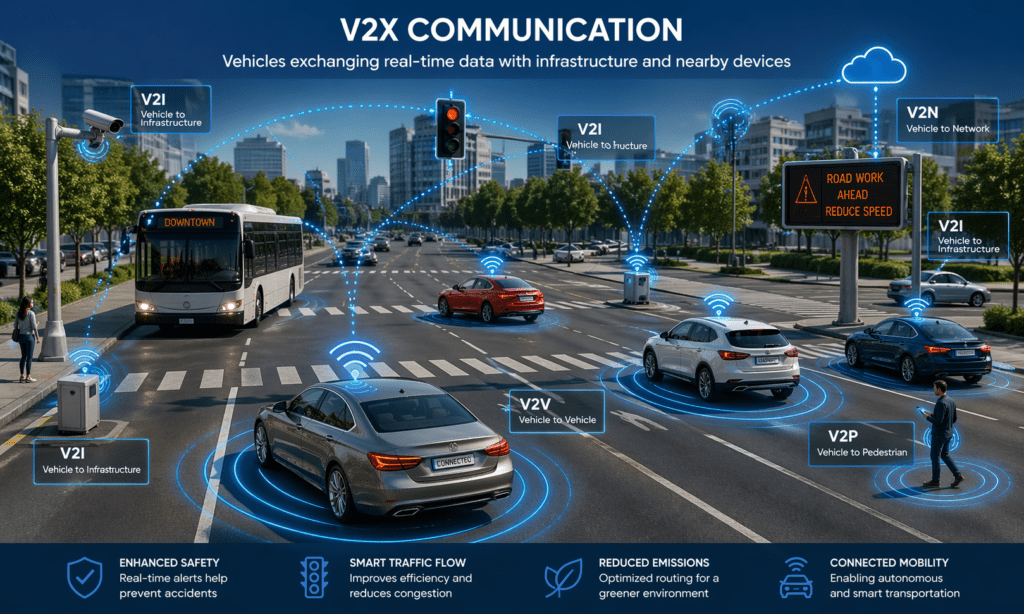
V2X is a networked communication infrastructure in which cars communicate with various parties in their surroundings. This involves communication with other vehicles, road infrastructure, pedestrians and cloud networks. The aim is to establish a single system in which each component is involved in enhancing traffic flow and safety.
Building Smart Traffic Ecosystems with V2X.
Real-Time Data Exchange
The V2X communication is based on real-time data exchange. Cars send and receive data about things like speed, direction, traffic and road conditions all the time. Such an unceasing stream of information enables systems to respond to changes immediately to minimize delays and enhance coordination of the whole traffic system. It makes sure that drivers and automated systems must never lose track of their environment beyond the physical eyesight.
Intelligent Traffic Management
V2X allows the traffic systems to be dynamic as opposed to being static. The traffic lights, signals and control systems are adjusted depending on the current traffic situation rather than using timers. This will eliminate congestion at crossings and have a smoother movement of vehicles. In the long run, information obtained through such systems can assist the authorities to maximize the urban planning and traffic policies.
Enhanced Road Safety
One of the greatest benefits of V2X communication is related to safety. The vehicles are able to sense any possible hazard like sudden braking or accidents, or even a pedestrian crossing the road. Alerts are immediately forwarded to surrounding cars and vehicles giving drivers more time to respond. This active safety system will lead to a significant decrease in the risk of collisions, as well as a general increase in road safety.
Important elements of the V2X Ecosystem.
Connected Vehicles
Connected cars are smart nodes of the ecosystem. They have sensors, GPS and communication modules and keep on collecting and sharing data. Such cars can comprehend their surroundings and act on them, which is why they are an essential component of the intelligent traffic system.
Smart Infrastructure
When communication technologies are incorporated into infrastructure, e.g. traffic lights, road signs, surveillance systems etc., they become smart. These systems can communicate with vehicles to give real time updates, control traffic flow as well as make roads safer.
Communication Networks
V2X systems require reliable and high-speed communication networks, in particular, 5G. They allow transmitting data with low latency and make sure that the information is received immediately. This is essential in emergency situations such as collision warnings and emergency responses that are time sensitive.
Advantages of V2X Communication.
Improved Traffic Efficiency
- Minimized congestion by optimal routing.
- Increased coordination of traffic lights.
- Movement at higher speeds in peak hours.
- Less fuel consumption as a result of smoother driving.
- Improved overall travel experience.
Enhanced Safety Measures
- Collision warning systems at an early stage.
- Real-time hazard notifications
- Improved pedestrian safety
- Priority of emergency vehicles.
- Minimized human error-related accidents.
Difficulties with the implementation of V2X.
Infrastructure Costs
There is a high cost of upgrading current infrastructure in order to implement V2X systems. This can be a challenge to developing countries especially in terms of resource allocation towards such massive transformations.
Standardization Issues
Various communication standards might be used by different manufacturers and regions causing compatibility problems. Global standardization is needed to ensure smooth interaction between systems.
V2X in Autonomous Driving.
Extended Awareness
Self-driving cars are dependent on situational awareness. Although onboard sensors offer local information, V2X is an extension of this information by sharing information outside of the immediate area of the vehicle. This assists autonomous systems to make superior decisions in more intricate settings.
Predictive Decision-Making
Autonomous vehicles will be able to predict and respond to possible dangers because they have access to real-time and predictive information, which they can modify their behaviour to avoid. This enhances the efficiency of navigation as well as minimizing risks that come about as a result of unforeseen occurrences.
Smart Traffic Ecosystems Future.
V2X has a future in being integrated with other smart city initiatives. With the development of technologies, such as artificial intelligence and IoT, the traffic systems will be more predictive and autonomous. This will reduce congestion, emissions, and enhance the quality of life in cities.
Conclusion
V2E communication is laying the groundwork to a new modern era of intelligent transportation. V2X links vehicles to their surroundings to form an effective and smooth traffic ecosystem, which puts safety and performance as a priority. Despite such challenges like the infrastructure costs and standardization, the long-term benefits of it are by far greater than the difficulties. V2X is becoming a key factor in the future of mobility, smarter, safer, and more sustainable transportation as it moves towards wider use.
Frequently Asked Questions (FAQs).
1. What is the meaning of V2X?
V2X is shortened Vehicle-to-Everything, which is a communication system between vehicles and the environment.
2. Which road safety does V2X enhance?
It gives real-time warnings of dangers, decreases accidents and enhances driver consciousness.
3. Will V2X be exclusive to autonomous vehicles?
No, it is beneficial both to traditional and autonomous cars as it improves communication and safety.
4. Which technologies are in support of V2X?
Efficient V2X communication is possible with the help of such technologies as 5G, DSRC, IoT, and cloud computing.
5. What are key issues of V2X adoption?
The main challenges include high costs, non-standardization, privacy of data, and network dependency.