Admin
Admin 
The financial environment is developing at a high rate, and the Agentic AI systems are shifting towards automation and full autonomy of decisions. These smart systems are able to manipulate huge amounts of data, forecast and implement financial solutions without human oversight. Consequently, the conventional role of CFOs is being redefined where AI is replacing operational and analytical roles and human beings are developing a strategic focus.
Agentic AI in Finance What is It?
HAutomation to Autonomy.
The agentic AI is a major breakthrough of conventional automation. These systems do not have pre-defined instructions and learn through data, evolving conditions, and make autonomous decisions. This implies that in finance AI can be used to do everything, including forecasting and compliance with a minimum of human intervention. The change enables organizations to adapt more quickly to the changes in the market and to work more effectively in the complex environment.
Key Capabilities
The agentic AIs are created in a manner that they are able to perform multiple financial tasks at the same time. They are able to process real-time financial information, identify trends and further enhance their performance. This potential allows companies to minimize the manual workload and enhance accuracy and acceleration in the financial procedures. These systems will be accurate over time, thus they are useful assets to long term financial planning.
Agentic AI is Replacing CFO-Level Decisions.
Forecasting and Planning of Finances.
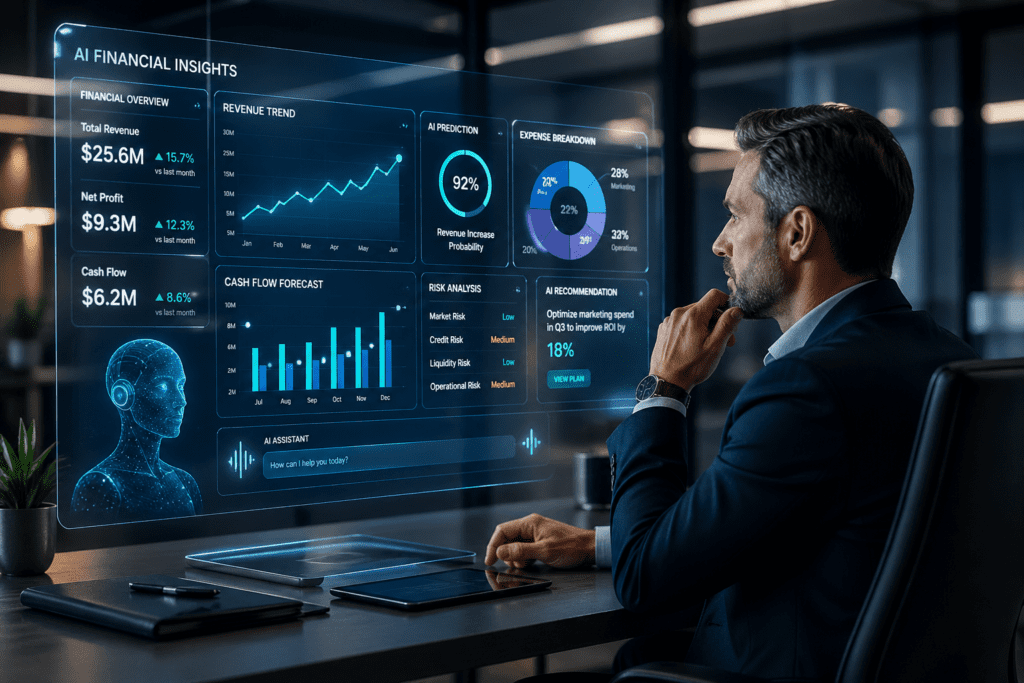
The agentic AI improves the forecasting process with real-time and enhanced predictive models. In contrast to the conventional approaches that are grounded on historical data, the AI constantly renews forecasts according to the data available in the market. This enables businesses to take the initiative and change strategies in real-time and minimize uncertainty and enhance financial stability.
Budget allocation and cost optimization.
The AI-based systems will have the ability to automatically allocate budgets according to performance metrics and business objectives. They keep track of expenditure habits and make dynamic adjustments in allocations in order to ensure maximum efficiency. This minimizes wastage and the resources are utilized where they maximize their returns.
Risk Management
The agentic AI continually surveys the internal and external sources of data to detect possible risks. Be it market volatility, fraud or regulatory changes, AI is able to identify problems in early stages and prescribe remedies. This preventive measure reduces financial losses and resiliency in the organization.
Strategic Decision-Making
AI systems can also offer high-level decisions through simulating various financial situations to give evidence-based recommendations. This comprises investment, mergers and expansion plans. Businesses have a great competitive edge due to the capacity to analyze a lot of possibilities within a short period.
Compliance and Reporting.
One of the most important aspects of finance is regulatory compliance. Continuous monitoring and automatic reporting are guaranteed by agentic AI, minimizing the chances of mistakes and fines. It also makes organizations abreast with the changing regulations hence ensuring uniformity in compliance.
Financial Agentic AI benefits.
- Enhances efficiency in operations by automating redundant financial operations.
- Improves accuracy by minimizing human errors and biases.
- Facilitates quicker decision-making based on the real time data processing.
- Scales up with the increase in the size of business and the volume of data.
- Gives greater detail with enhanced analytics and forecasts.
Obstacles and threats.
- Too much dependence on AI can decrease the control of humans in important decision-making.
- The more automation there is, the more data privacy and cybersecurity issues get jeopardized.
- Ethical issues on responsibility about AI decisions.
- The cost of implementation is high and it is very technical.
- Reliance on quality data to be accurate in performance.
Future of CFOs.
Decision-Maker to Strategists.
With the routine and analytical work being automated and replaced by Agentic AI, CFOs are becoming more strategic. They will work on projecting business direction, being ethical in the application of AI, as well as aligning financial strategies with long-term objectives. With this change, finance leaders can focus on innovation and value creation.
Human-AI Collaboration
Human and AI collaboration is going to be the future of finance. As AI will be involved in processing and executing data, CFOs will interpret data, add context, and make the final strategic decisions. This collaboration makes sure that efficiency and human judgment is preserved.
Conclusion
The finance industry is undergoing a revolution, whereby complex decision-making processes that are handled by CFOs are being replaced by agentic AI. The way organizations are run is changing due to its capability to analyze, make predictions, and behave independently. But the contribution of human leadership is still very important in leading the strategy, ethical practices, and risk management. The future of finance is in a harmonious collaboration of AI potential and human knowledge, in which they will collaborate to lead more intelligent and sustainable business decisions.
Frequently Asked Questions (FAQs).
1. How is Agentic AI different from conventional AI?
The concept of agentic AI is that it is not meant to be controlled by humans, but rather to make decisions and take actions without any human involvement. Customary AI generally involves pre-established rules and supervision by human beings.
2. Is it possible that Agentic AI can completely replace CFOs?
The agentic AI is not able to fully substitute the CFOs but can considerably decrease the amount of operational work they have to do so that they are able to concentrate on the strategic leadership and governance.
3. Has Agentic AI been safe in the financial decision-making process?
When applied with appropriate security measures such as data protection, human supervision, and morality, it is mostly safe.
4. Which sectors of the financial industry can be most useful with Agentic AI?
The most benefiting industries are those in the banking sector, fintech, insurance, and large businesses as they have complex financial processes.
5. So, what are the skills that CFOs will require in the AI era?
To work efficiently with AI systems, CFOs will require data analysis and AI management skills, strategic planning, and risk assessment.